
Ready for the magic formula? Drumroll, please. For a simple hanging object, tension equals mass times gravity. That’s it: \( T = mg \). Yes, the same \( mg \) that dropped Newton’s apple. But wait—there’s a catch.
That equation only works if the object is not accelerating. If it’s just hanging there, minding its own business, tension equals weight. Boring? Maybe. Useful? Absolutely. But if you start yanking that rope up or down, tension throws a fit.
When things move, tension gets spicy.
Say you’re hoisting a fridge (because you do that in your spare time). If you lift it with acceleration, tension changes. The new formula is \( T = m(g + a) \) when accelerating up. That plus sign means the rope works harder because it has to fight gravity and lift faster.
Twist it the other way: if you’re lowering the fridge gently (maybe an apology gift), tension becomes \( T = m(g - a) \). The rope gets a break! Physics is like a moody teenager—totally dependent on context.
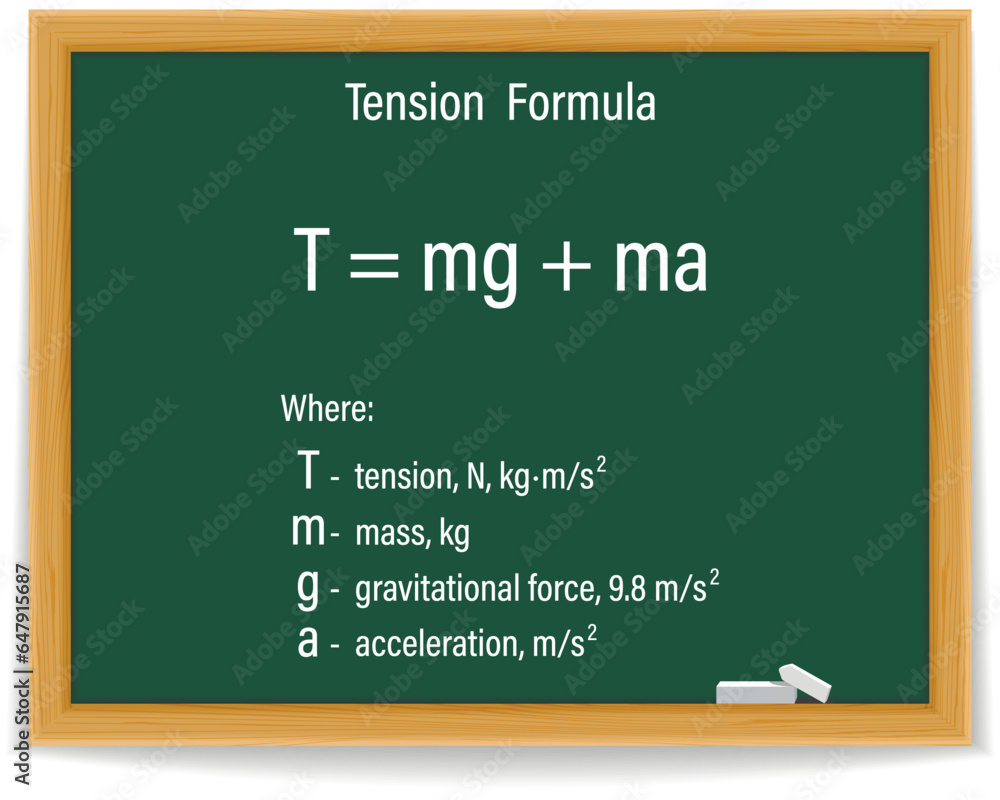 Tension Formula on a green chalkboard. Education. Science. Formula

