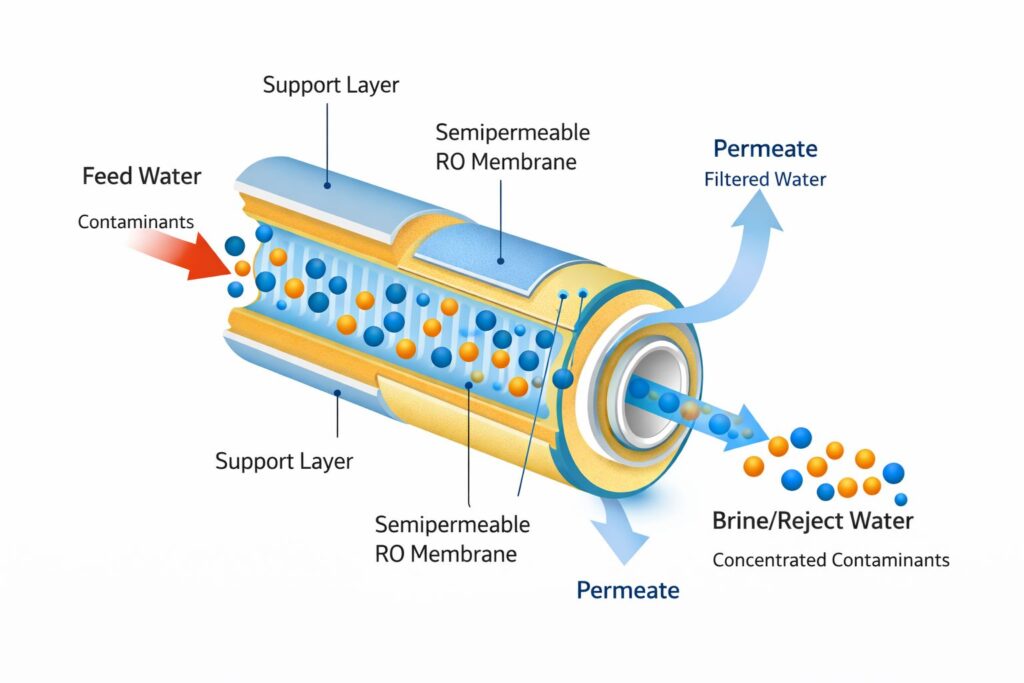
Pretty much everything you don’t want in your glass. The RO membrane stops dissolved salts, heavy metals like lead and arsenic, and even microscopic viruses and bacteria.
Think of it as a net that catches the stuff you can’t see with your naked eye. It’s the reason why RO water is often used in hospitals and labs—they trust it to be pure.
But here’s the fun twist: it’s so good at its job that it also blocks healthy minerals like calcium and magnesium. That’s why some RO systems add a remineralization step afterward—so you don’t end up with water that’s “too clean” and flat-tasting.
The Two-Lane Highway Analogy
Imagine a highway with a toll booth that only lets sedans (water molecules) through. Big trucks (contaminants) are forced to take a detour. But here’s the catch: the highway has to flush those trucks away every so often, or they’ll clog the booth.
That’s why RO systems have a drain line. About 75% of the water that enters your system never makes it to your glass—it’s used to wash away the trapped gunk. Yes, it’s a bit wasteful, but newer membranes are getting way more efficient.

